Does AI really make it possible for everyone to “create Micro drama”?
By Jieyu Bai
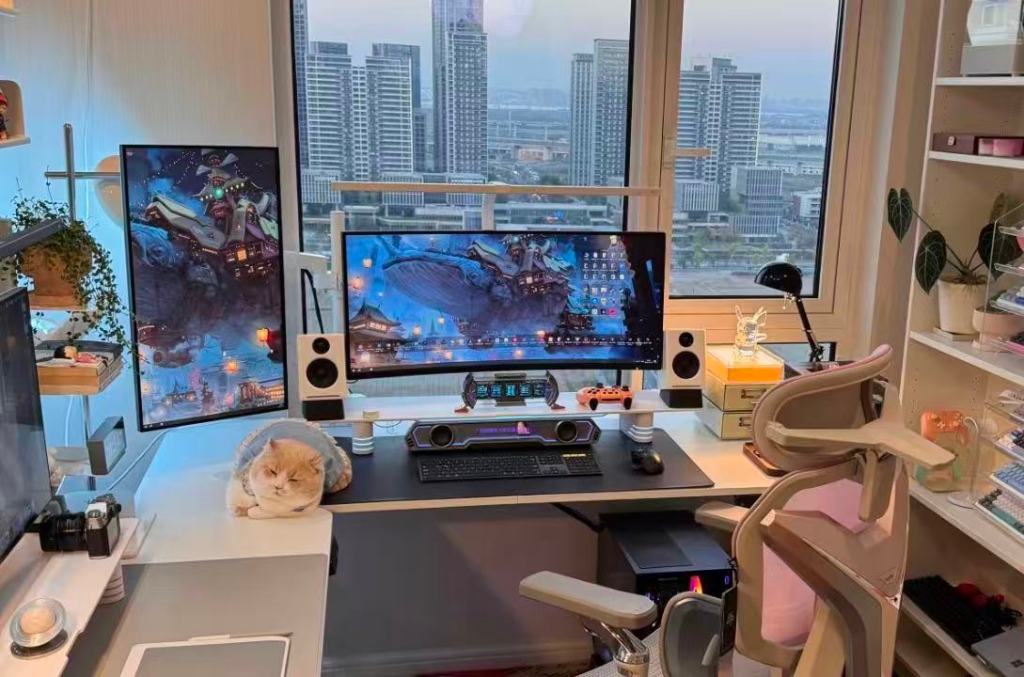
A multi-screen home workspace shows how digital production can increasingly take place outside a traditional studio. Photo by Yoyo Miao. Used with permission.
No studio, no actors, even not a camera. Generative AI is packing some of the work used to be done by professional film into a single computer. As production barriers start lowering, has the era “everyone could make a movie” truly arrived?
Imputing few sentences can prompt AI to generate a character. With another few prompts, then AI can place that character in a café. A shot that once required camera, sets, and a post-production team, now AI can generate it.
“Create a micro drama” seems to become something that might do not require actual “filming”.
Film studio is shrinking
The various tasks that were previously scattered across multiple. Now they are being consolidated into a single digital interface.
Flow, the AI filmmaking tool introduced by Google, directly positioning the product as a tool for visual storytelling and film production. Meanwhile, Runway, the AI video generation and creative production tool, providing a complete workflow from character design, shot generation, to post-production editing.
One of the biggest barriers in traditional film and television production has never been whether there is a great story, but rather whether there are resources to turn the great story into visuals.
Now, generative AI has enabled individuals to test creative ideas that were previously beyond their reach with a low cost. It did not suddenly produce greater stories, but allow more people with the opportunities to “give it a try”.
Micro drama was already fast, while AI makes it faster
The popularity of AI micro drama does not emerge out of zero. Before the maturity of generative AI tools, micro drama had already developed a suitable narrative style for mobile devices.
Compared to a two-hour film which needs to maintain consistency of characters and scenes, micro drama are more easily broken down into individual shots. Meanwhile, the generative AI tools are perfectly suitable for this.
In China, AI-generated micro dramas have already reached significant commercial scale. In February 2026 alone, the top 100 AI-generated animated short dramas received approximately 7.59 billion views.
However, “easier” does not mean “easy”
The greatest allure of AI is to make video creation seem as simply as clicking a button. But reality is far from that simple.
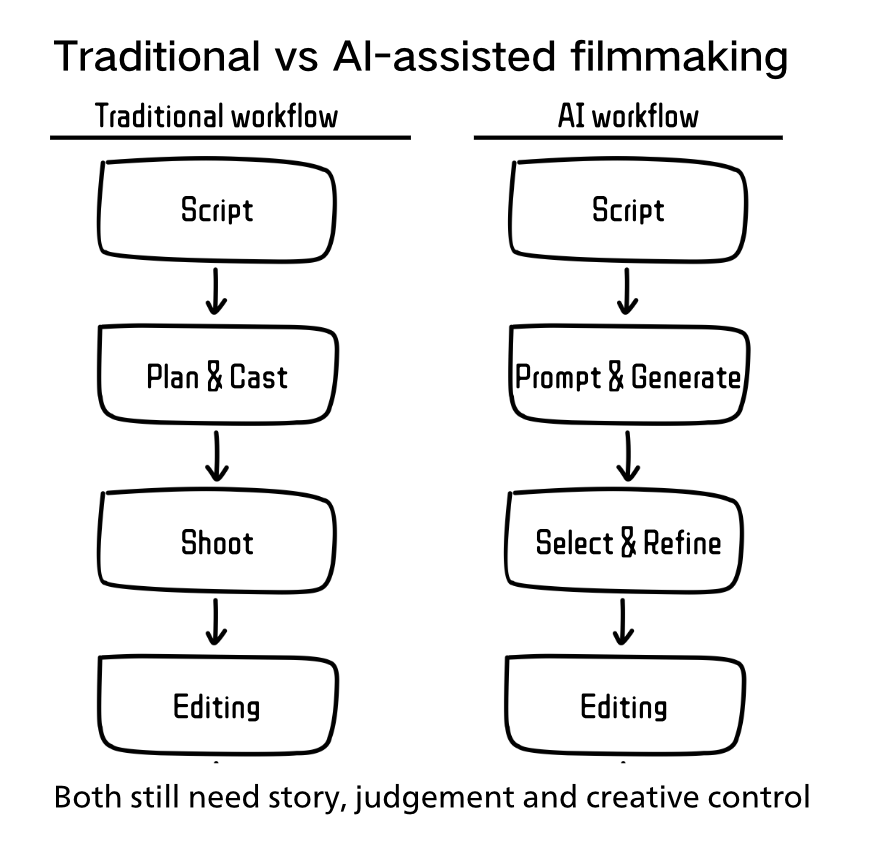
Instruction of how to create longer videos and films introduced by the Runway, still requiring creators to build story structure, storyboard, design shoots, then resolve the issue of character consistency through character plates from different perspectives.
It reveals an interesting change: AI does not eliminate the professionalism of film and television production. Instead, it has merely reorganized it.
Previously, the focus was on determining the placement of the camera. Now, the focus turns to decide which generated shots are worth keeping. The creators also need to manage production models, prompts, and a large number of failed generated results.
That means the technical threshold has decreased, but the thresholds of narrative, aesthetics, and judgements have not disappeared along with it.
If there is no actor on set, who owns the performance?
When AI begins to take on creative work, the key remains how much creative control humans have over the final work expression.
The U.S. copyright office pointed out in Artificial Intelligence Study that, AI involvement does not automatically strip a video work of copyright protection, while mere prompt providing is usually insufficient to support human authorship. SAG-AFTRA also highlights in its AI framework: “The A.I. guardrails SAG-AFTRA employs are clear consent, fair compensation, control over performances“.
The boundaries of actors are also being redefined. When real actors’ faces, voices, or movements could be transformed into digital replicas, it rises the issue that who has the right to use these digital identities, for how long, and who should be compensated.
Everyone can start, but not everyone can make it work
The set does not vanish, while it has been incorporated into a new workflow.
AI tools reduce the reliance on photographic equipment, venue, even actors. But it is impossible to generate great video works in one step. However, the video stories whether is worth watching, the selection of the camera, and whether the characters can resonate with the audience. There are still questions that need to be answered by the creators themselves.

 yourdomain600.blog
Leave a comment